Breast Cancer, Lymphedema, and the Shoulder Girdle: Separating Fact from Fiction
Beating breast cancer is a significant achievement. Unfortunately, many survivors face challenges that don’t always get the same attention as the cancer itself, particularly in the shoulder girdle, the structure that connects your arms to your trunk. Lymphedema, scar tissue, and surgical-related trauma in the area can have a profound impact on your day-to-day life.
At Rising Sun Physical Therapy, we’ve found that many people will buy into misconceptions about these issues that can prevent them from getting timely care. Let’s break some of them down.
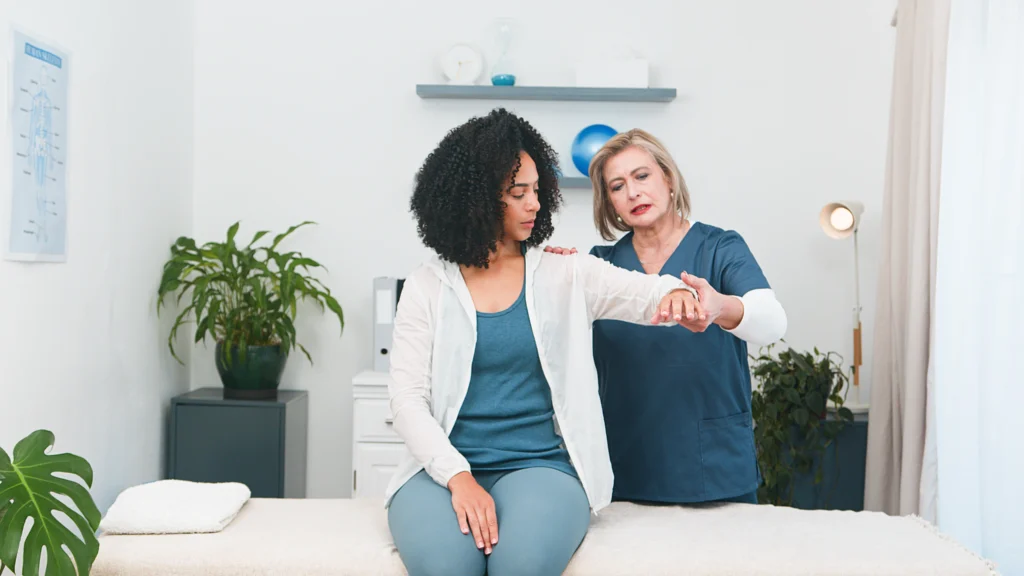

Four Breast Cancer Recovery Myths That Need Debunking
Myth 1: “Lymphedema is rare. I don’t need to worry about it after breast cancer.”
Fact: Lymphedema is one of the most common complications after breast cancer treatment.
Lymphedema occurs when lymph fluid, which normally helps clear waste and support the immune system, builds up in the body. The two main treatments for breast cancer–lymph node removal and radiation therapy–also dramatically increase the risk of developing the condition.
Lymphedema symptoms develop gradually, and they may start to show up months after treatment. If you’re a breast cancer survivor, it’s essential that you keep an eye out for early signs, which will be very mild. But because lymphedema is a progressive condition, early intervention with our team is essential for a good outcome.
What To Watch Out For
- A heavy or tight feeling in the arm or chest
- Rings, sleeves, or watches suddenly fitting tighter
- Mild swelling that doesn’t go away
Myth 2: “If I already have swelling, there’s nothing I can do.”
Fact: Several proven treatments can relieve swelling and improve mobility.
At Rising Sun Physical Therapy, we offer comprehensive treatment for lymphedema and post-surgical swelling. If your lymphedema is still in the early stages, we can provide guidance to prevent it from worsening. If it’s more advanced, we can help you manage your symptoms.
Treatment Techniques We Offer
- Lymphatic drainage therapy, a gentle hands-on technique that helps fluid move through the lymph system, easing swelling and discomfort
- Laser therapy using a non-invasive Class IV laser treatment to stimulate healing in damaged tissue and help reduce pain
- Compression therapy consisting of sleeves, garments, or layered bandages that prevent fluid from pooling in the arm or chest
- Exercise therapy to promote circulation, keep joints mobile, and help prevent further swelling
Myth 3: “Shoulder stiffness is just part of recovery. It will go away on its own.”
Fact: The shoulder girdle often needs focused care after breast cancer treatment.
The shoulder girdle includes the collarbone, shoulder blade, and muscles that allow your arms to lift, rotate, and reach. Breast cancer-related surgeries, including mastectomies and lumpectomies, involve cutting through the tissue in this area.
If you skip post-surgical rehabilitation, you risk developing scar tissue that can cause long-term restriction. As with lymphedema, early intervention is crucial for reducing scar tissue before it becomes a problem. Waiting for any lingering restriction to work itself out often worsens pain and stiffness.
How Physical Therapy Makes a Difference
- Gentle, targeted stretches loosen scar tissue
- Hands-on manual therapy can help reduce pain and improve motion
- Strengthening exercises to restore shoulder stability and function
Myth 4: “If I don’t have symptoms now, I don’t need to see a therapist.”
Fact: Prevention is one of the most effective tools for long-term health after breast cancer, especially when it comes to lymphedema.
Lymphedema is not an inevitability after breast cancer. A few simple strategies can play a big role in keeping the condition from developing. The same is true for restrictions in the shoulder girdle.
The number one tip we suggest for avoiding these complications is scheduling an appointment at Rising Sun Physical Therapy shortly after your recovery. Our physical therapists can perform a comprehensive evaluation and let you know your particular risk factors while providing a personalized prevention plan.
Simple Prevention Strategies To Adopt Now
- Be vigilant about damage to the skin of the affected area. If you do scratch or injure it in some way, wash it with soap and water, apply antibiotic ointment, and monitor for swelling and redness.
- Gradually build up activity in the shoulder girdle and take frequent breaks to allow time for recovery.
- Avoid constricting the affected limb.
Sources: https://www.sciencedirect.com/science/article/abs/pii/S1011134415002432?via%3Dihub, https://pubmed.ncbi.nlm.nih.gov/33887538/, https://www.sciencedirect.com/science/article/abs/pii/S0003999321013587
Take Charge of Your Recovery at Rising Sun Physical Therapy
Breast cancer may be behind you, but ongoing care keeps you healthy and active. Our whole-body approach will consider your physical, emotional, and functional well-being, helping you thrive for years to come.
Schedule your appointment online or email us at support@risingsunphysicaltherapy.com to get started.
Balance Beyond Physical Therapy
Balance isn’t just about exercises—it’s about presence, rhythm, and connection. In this blog, Bettina-Kira Neumann shares how physical therapy and 5Rhythms® somatic dance come together to build steadiness, confidence, and longevity. Discover why balance matters at every age, and how you can begin strengthening yours today.
Better balance means more confidence, fewer falls, and greater freedom. Learn how somatic movement and physical therapy work together.
Balance Beyond the Clinic
I’m Bettina-Kira Neumann, physical therapist and founder of Rising Sun Physical Therapy and Aurras Transformation. What I’ve learned—for myself and for my patients—is this: balance isn’t just built in the clinic. It’s built every time you come back to your body with presence, rhythm, and connection.
That’s why I created My Body, My Temple—a 6-week 5Rhythms® somatic dance series. Each Thursday night we’ll move with a different part of the body—feet, pelvis, spine, heart, hands, head—releasing tension, rebuilding awareness, and finding steadiness from the inside out.
If you’re ready to return to your body as a place of memory, power, and presence, this is your invitation. I recommend making it a regular practice—because that’s where the real change happens.
📍 Joe Goode Annex, Sept 18 – Oct 23, Thursdays 7:00–8:30 PM
👉 Sign up for the full series or drop in when you can.

Healthy Snack: Apple Nachos
- 2 apples, any variety
- 1/4 cup creamy nut butter
- Toppings of your choice (granola, shredded coconut, caramel, slivered almonds, raisins, etc.)
- Slice apples thinly and arrange on a plate.
- Melt nut butter in the microwave (30-60 seconds). Stir.
- Drizzle nut butter over the apples.
- Top with a sprinkling of your choice of toppings.
- Serve immediately.